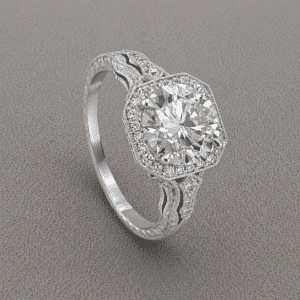
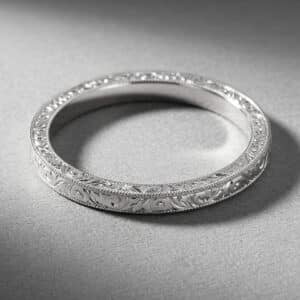
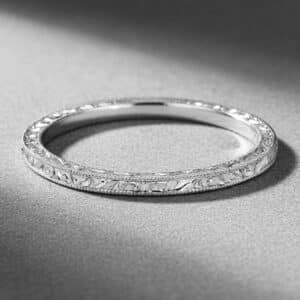
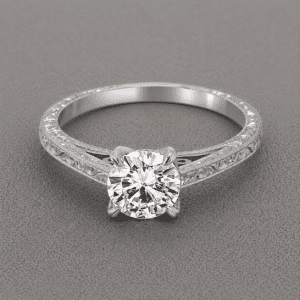
Engraver cutting a scroll pattern into a gold wedding band with a hand graver

The Lost Art of Hand Engraving in Jewelry: History, Style, and Why It Still Matters

Hand engraving looks simple until you watch someone do it. A sharpened point meets metal, and a line widens into a leaf, turns around a curve, then disappears into a border. That line is cut into the surface. The engraver must control the tool, the metal, and the direction of the cut at the same time. Done well, the pattern has light and shadow that change as the ring moves. It is beautiful because making it look effortless takes years of practice.

1. An Art with a History Beyond Jewelry

A hand engraver guides a small, sharpened cutting tool called a graver through metal. Each pass removes a fine shaving. Tilting the tool can widen a line; lifting it gradually can bring the line to a fine point. A polished cut reflects light differently from the shaded metal beside it. On a curved ring, the engraver must keep that control as the pattern travels around the band.

Engraving has long served purposes beyond decoration. Ancient signet rings carried names, figures, or symbols that could be pressed into a seal. This Roman-era gold seal ring in the British Museum bears an engraved figure of Isis. A small object could identify its owner and make a recognizable mark. www.britishmuseum.org

The craft was used on many materials, not only the gold, platinum, and silver familiar in fine jewelry. Artists cut copper plates to make prints and decorated steel objects as well as precious metal. Albrecht Dürer’s engraved prints show the extraordinary range of texture that can be created through cut lines. Printmaking is a different discipline from engraving a ring, but both depend on control of the tool and an understanding of how a line will appear. resources.metmuseum.org

Engravers and goldsmiths also worked for European courts. Étienne Delaune designed jewelry and ceremonial armor and served as an engraver at the Royal Mint under Henry II of France. The Metropolitan Museum of Art preserves one of the armor designs associated with that royal work. It is a reminder that carefully worked metal once expressed identity, status, and artistic ambition on a much larger scale than a ring. www.metmuseum.org

Today, the word “engraved” can describe several processes. A laser follows a digital design; a CNC tool cuts a programmed path; a decorative shape can be formed during casting. Each can be useful. In hand engraving, the artist directs the tool through the metal, adjusting the shape and direction of the cuts as the work develops. A machine-made mark is not automatically poor, and a hand-cut mark is not automatically excellent. The important questions are how the pattern was made and how well it suits the object.

Engraving gravers beside a secured wheat-pattern band, with scroll and geometric bands behind it

2. Styles, Tools, and the Work at the Bench

Scrollwork follows curves that branch into leaves, vines, and flowers. Wheat engraving uses repeated angled cuts to create a more regular rhythm and a fine shimmer across a band. Geometric patterns rely on straight lines, stars, chevrons, and repeated panels. A braid or a Celtic knot is not the same as wheat: if a customer wants a particular symbol, it must be drawn at a scale that remains clear on the ring’s curved surface.

To begin, the engraver secures the piece in a vise or rotating engraving ball. The design may be drawn or transferred onto the metal. Good lighting and magnification help with fine work. Some engravers push the graver by hand; others use a pneumatic handpiece that delivers controlled impacts. The handpiece supplies force, but the engraver still steers the tool and decides where each line starts, turns, widens, and ends.

The shape of the graver affects the mark it makes. A pointed tool can cut fine lines and V-shaped grooves. A flat graver can create a wider, bright cut, while other shapes help with shading and texture. The tool must be sharpened carefully: its cutting face and small underside bevel, called the heel, influence how it enters and moves through the metal. A poorly prepared point may dig in, slip, or leave a rough line. Sharpening is part of the engraver’s skill, not simply a task done before the artistic work begins. grs.com

The artist turns the secured ring as the pattern develops, taking controlled cuts rather than attempting one continuous carve around the band. A domed surface, flat band, or knife edge changes the space available. Stones, prongs, and borders create further limits. That is why the pattern must be planned for the particular ring. Two rings can follow the same drawing and still have small differences in their individual cuts; what matters is that each pattern flows clearly and holds together as a design.

Hand engraving remains compelling because you can examine both the image and the work that created it. Choose a band width and profile that give the pattern room to be seen. Ask where the engraving will appear, whether it continues around the full ring, and which details are actually cut by hand. A fine engraved piece rewards that attention long after the first glance.

OroSpot Custom Engraved Rings

Shop for gold, rose gold, platinum, and sterling silver engagement rings at a great price!

Leave a Comment

Your email address will not be published. Required fields are marked *

Shopping Cart
Scroll to Top
1 Shares
Tweet
Share
Pin1
Share